The Strange Image of Judas at Vezelay (and What It Teaches About God’s Mercy)
This reflection explores the powerful imagery of Judas found at Vézelay Abbey in France, inspired by a Palm Sunday message from Bishop Robert Barron. What does this ancient carving reveal about God’s mercy, human despair, and the limits we often place on grace?
CHRISTIAN CARTOONSGRACE AND MERCY
Opa
God’s Mercy and Its Limits? A Lesson from Vézelay
This morning, I (Opa—this is the cartoon creating guy) listened to a Palm Sunday message from Bishop Robert Barron. In that message, he referenced the carvings at Vézelay Abbey—particularly the ones showing Judas.
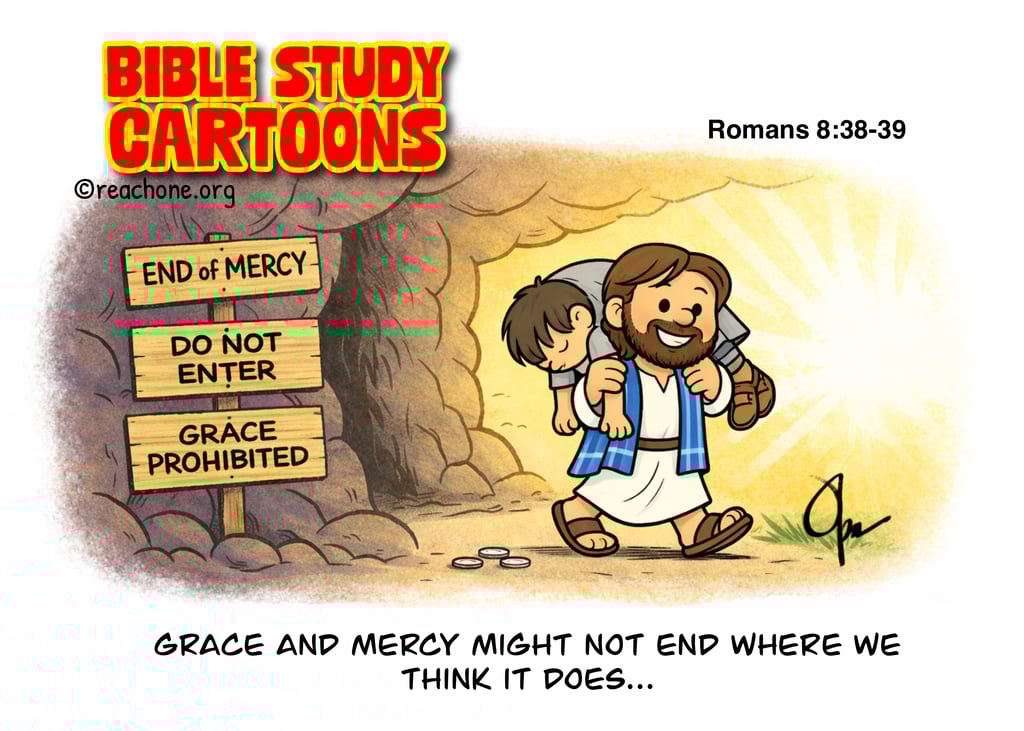
One depicts Judas hanging himself—but another! Well, it showed something I had never really considered before. It was the Christ carrying Judas on His shoulders… as if Judas was a lost sheep. Perhaps even, one who had repented at the time of his death.
I’ll be honest.
That image stopped me… that’s not how I’ve always pictured Judas.
I tend to keep Judas in a very small, very defined box. He was:
The traitor
The villain
The one who got it wrong beyond repair
Thirty pieces of silver.
A kiss in the garden.
End of story… Right?
Carved In Stone
But that carving doesn’t let the story of Judas end quite so neatly.
It doesn’t excuse Judas.
It doesn’t ignore what he did.
It shows the betrayal.
But it also suggests something deeper:
👉 Christ didn’t stop being Christ.
Where Does Grace End?
Not at betrayal.
Not at failure.
Not even at despair.
And that’s where things get uncomfortable. Let’s be clear—HELL is real and people (souls) are going there for eternal damnation. That is a fact! It is what it is! And that is not the point of this conversation.
The question that confronts us all when we contemplate the carvings at Vézelay Abbey isn’t just about Judas. It’s about us. And it’s about mercy and grace.
How far does mercy go?
Is there a point where grace ends?
Or do we draw that line… long before God does?
We often hear the difference between Peter and Judas explained this way:
Peter failed—and returned
Judas failed—and gave up
If that’s true, then the real tragedy of Judas may not be betrayal alone…
…but despair.
The belief that mercy was no longer possible. And that’s where that ancient carving starts to feel very personal. Because most of us have had moments—quiet ones—where we’ve thought:
“Well… I’ve probably gone too far this time.”
But if that image at Vézelay is even pointing toward the truth… then maybe the story doesn’t end where we think it does.
And maybe grace doesn’t stop where we think it does.
📖
Romans 8:38–39
For I am convinced that neither death nor life… nor anything else in all creation, will be able to separate us from the love of God in Christ Jesus our Lord.
Our Story
Well, that’s our story… and we’re sticking to it.
If you’ve ever messed up your life like Opa has messed his up, repent! Turn back to Jesus. It’s NOT okay to sin—but it is alright to repent! Acknowledge your error—better yet! Confess your sin! Get rid of it! And put your trust in the blood of Jesus!
That’s His story! And He wants you to be part of His story too!
Thank you, Jesus!
Vivat Jesus!